Building This Blog with Claude Code and Proxmox
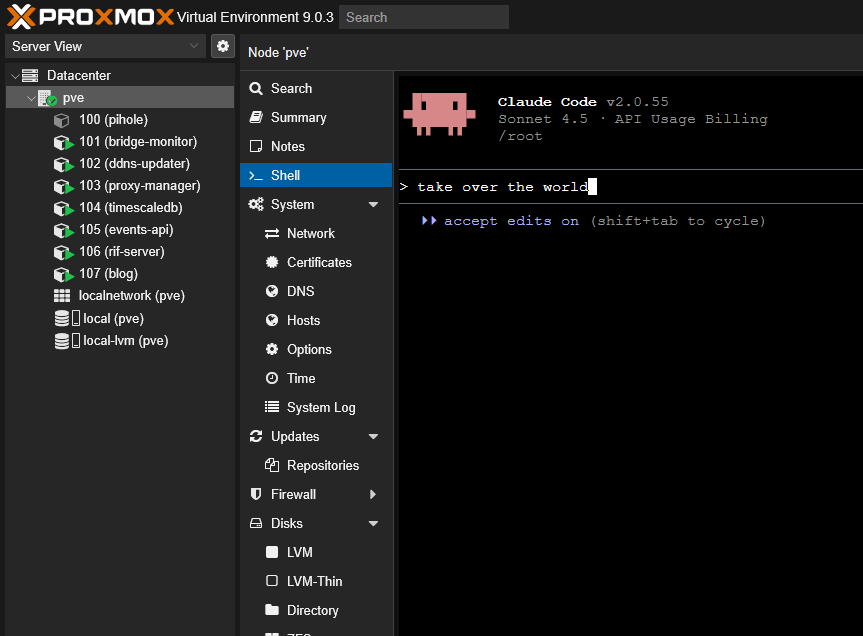
This blog was built to replace a WordPress site at jacob-hoover.com that cost $118/year. Instead of continuing to pay for hosting, I migrated everything to a self-hosted Hugo static site running in an LXC container on Proxmox VE. The entire deployment was handled by Claude Code running on the Proxmox host, which had visibility into the existing infrastructure of 7 other containers (bridge monitor, events API, TimescaleDB, nginx proxy manager, DDNS updater, RIF server, and Pi-hole).
The infrastructure consists of a Lenovo M920T running Proxmox with containers segmented across VLANs for management, services, and untrusted devices. Physical network preparation included running four Cat6 cables through the house and configuring a managed switch. All public-facing services route through container 103 (Nginx Proxy Manager) which handles SSL termination and forwards requests to internal container IPs.
Claude Code received a single prompt to analyze the existing WordPress blog, create a new container, scrape all content and images, build a Hugo theme, configure DNS through Porkbun, update the proxy manager and DDNS updater containers, and apply security patterns consistent with the existing infrastructure (non-root execution, CORS restrictions, rate limiting, audit logging). The deployment included a FastAPI CMS backend with Google OAuth authentication, allowing in-browser editing with a WYSIWYG interface. Total execution time was approximately 45 minutes from prompt to functional site.
Running Claude Code on the Proxmox host rather than within individual containers enabled architectural consistency across the entire infrastructure. It could verify that new containers followed established security patterns, prevent IP conflicts, coordinate changes across multiple containers simultaneously, and ensure integration points (DNS, proxy configuration, SSL certificates) were handled correctly. This represented a shift from using AI for code completion to using it for infrastructure orchestration with full system context.