The Fountain Lights
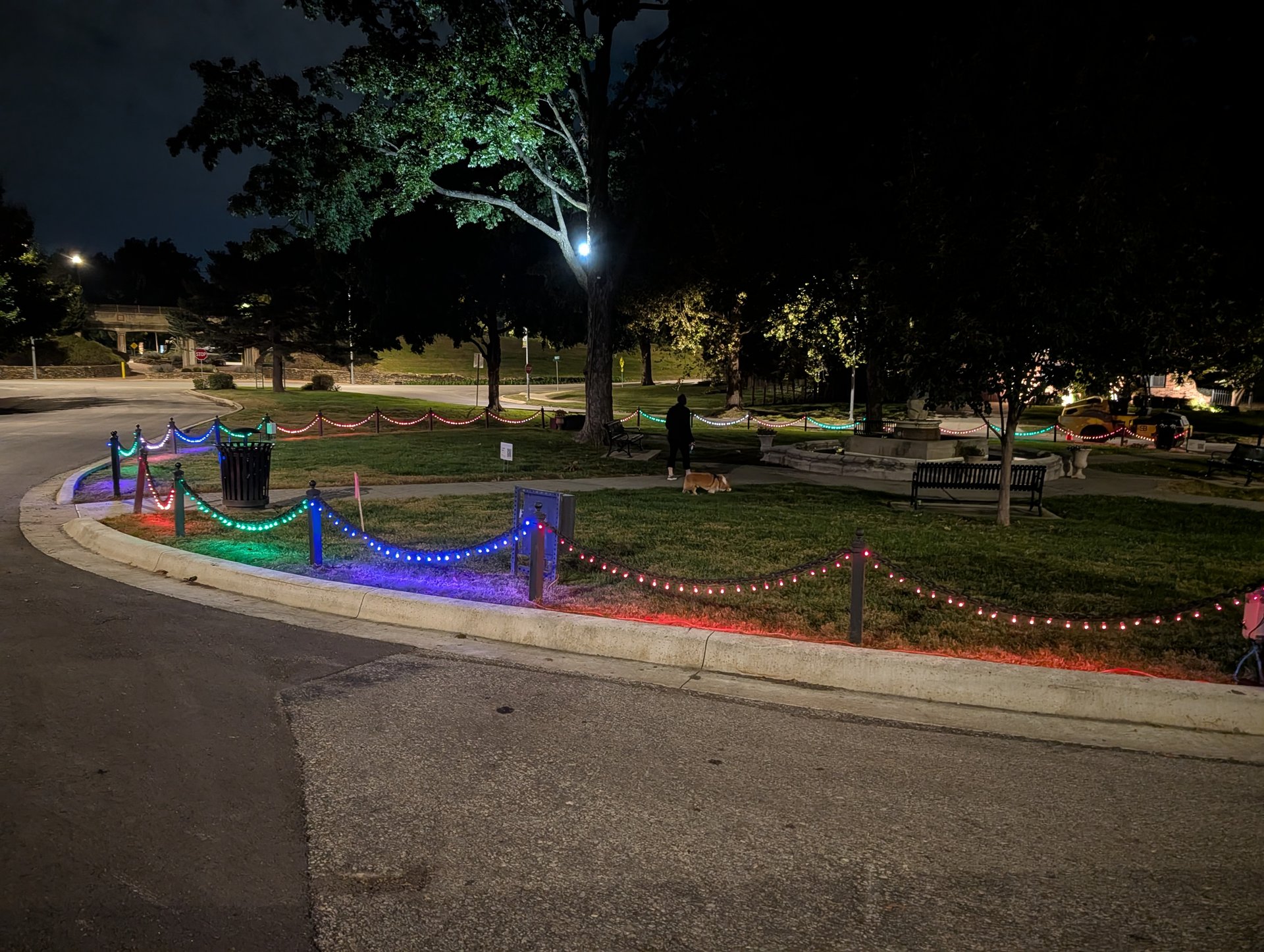
There’s a fountain in the middle of my neighborhood with a chain fence around it. It now has a thousand LEDs on that chain, and anyone standing there can scan a sign and pick what the lights do from their own phone. No app, nothing to sign up for. The website renders the same show in 3D, so you can watch it from anywhere, The shows are built around the shape of the chain itself: 107.5 feet across, forty sagging spans.
If your time is short: the photos below cover the build. Otherwise, here’s how a neighborhood fountain ended up with a jukebox.
The ring
Before any of this I went out and measured it. The ring is 107.5 feet in diameter on both axes, so it really is round. Four quadrants of eleven posts, separated by four sidewalk gaps of 84 inches each, which gives ten chain spans per quadrant and forty in total. The posts are 26 inches tall and the chain hangs to 14 inches at its low point, so every span is a catenary with 12 inches of sag.
Pixel spacing wanted to be 4 inches along the curve of the chain, but the spans aren’t identical — they run from 79 to 91.5 inches center to center. I could have varied the count per span and kept the spacing perfect, or fixed the count and let the spacing vary. Fixed count won, because the longest span sets it: 25 pixels fits the 91.5-inch span with about four inches of margin, and the short spans just bunch a little tighter. Pixels can bunch, they can’t stretch. Forty spans at 25 pixels is 1,000 LEDs.
That geometry is a single module that solves the catenary numerically and hands back every pixel’s position in space, its height off the ground, and where it sits along its span. The browser imports it, the server imports it, and the Raspberry Pi at the fountain imports it. Same file, same math, no copies. That matters more than it sounds, and I’ll come back to it.
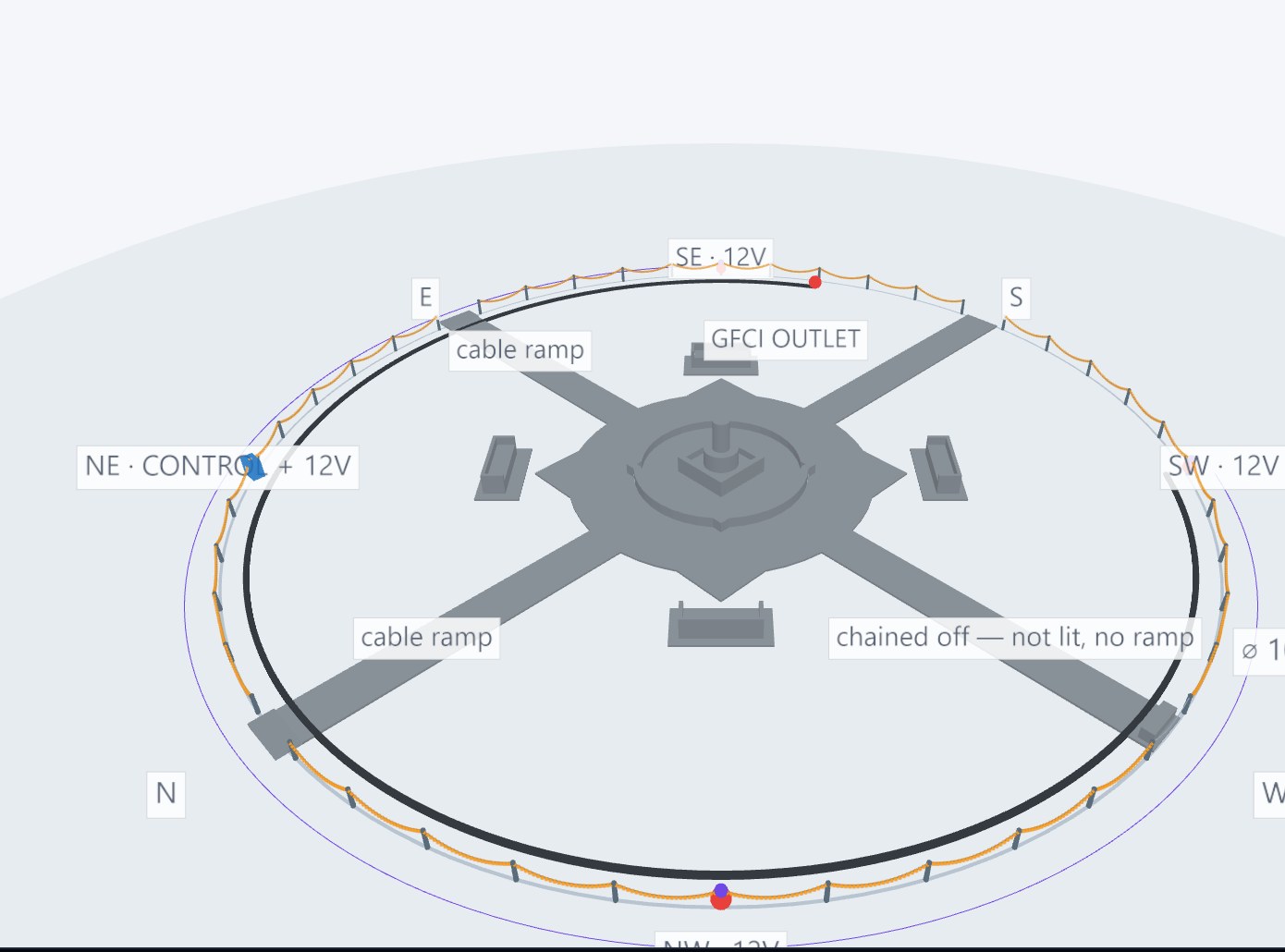
The plan from the site’s “how it works” page: four quadrants, four 12V feeds, the control box in the northeast, cable ramps where the runs cross the walkways. One quadrant was chained off at the time with no ramp.
Hardware
A Raspberry Pi 4 and a Falcon F16V5 controller live in a box in the northeast quadrant, with a 12V supply. The F16V5 feeds one quadrant directly and drives three SRx1 differential receivers over Cat5e — one per remaining quadrant — because sending pixel data 80 feet down a chain fence as single-ended signal is how you get a light show with a stutter. The pixels are 12V WS2808 dual-data IP68 bullets, center-fed in runs of 125, one supply per quadrant, no injection.
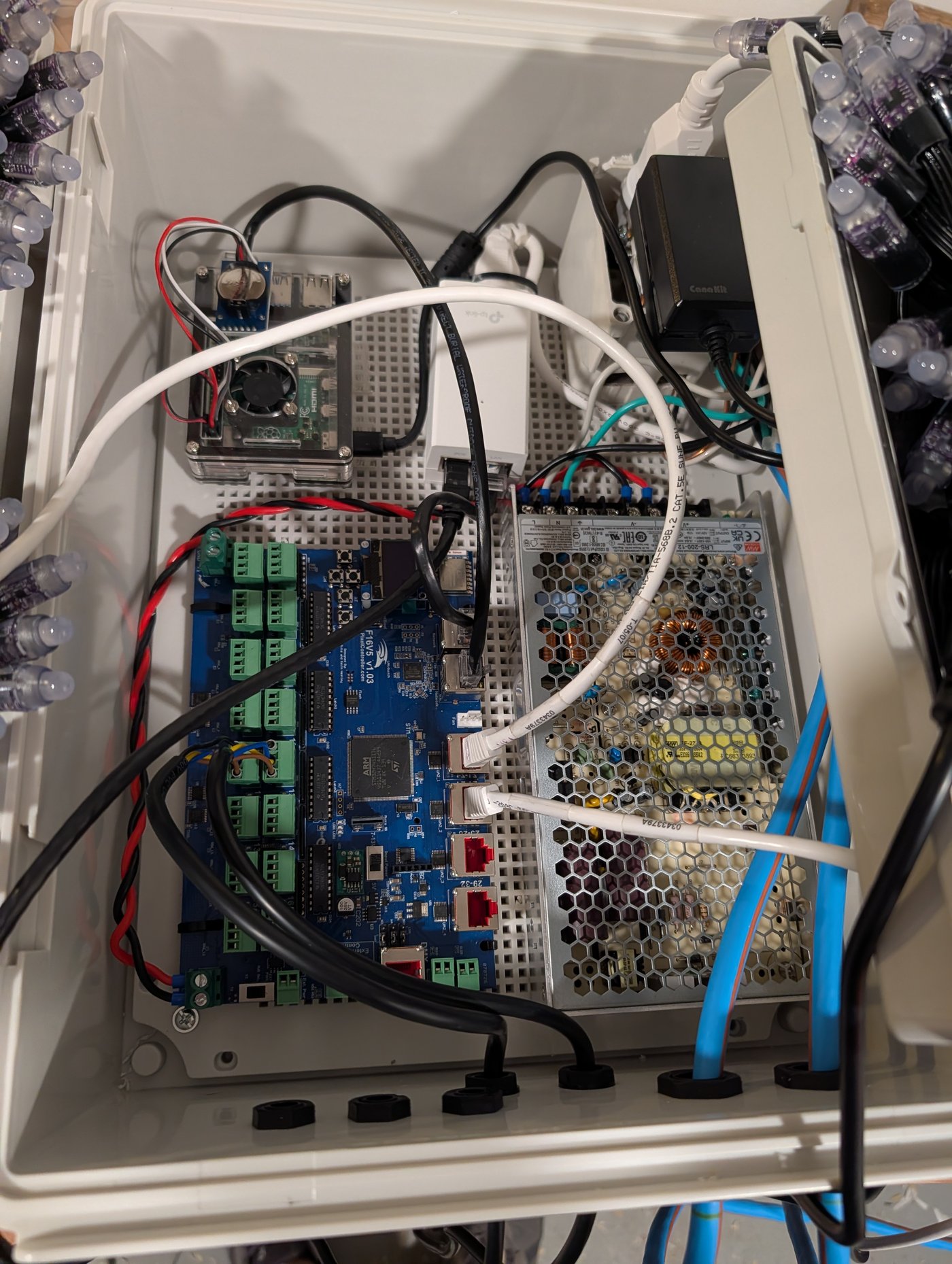
The control box. Pi, Falcon F16V5, 12V supply, and a wireless bridge radio. The RTC module stuck to the Pi is there for a reason I’ll get to.
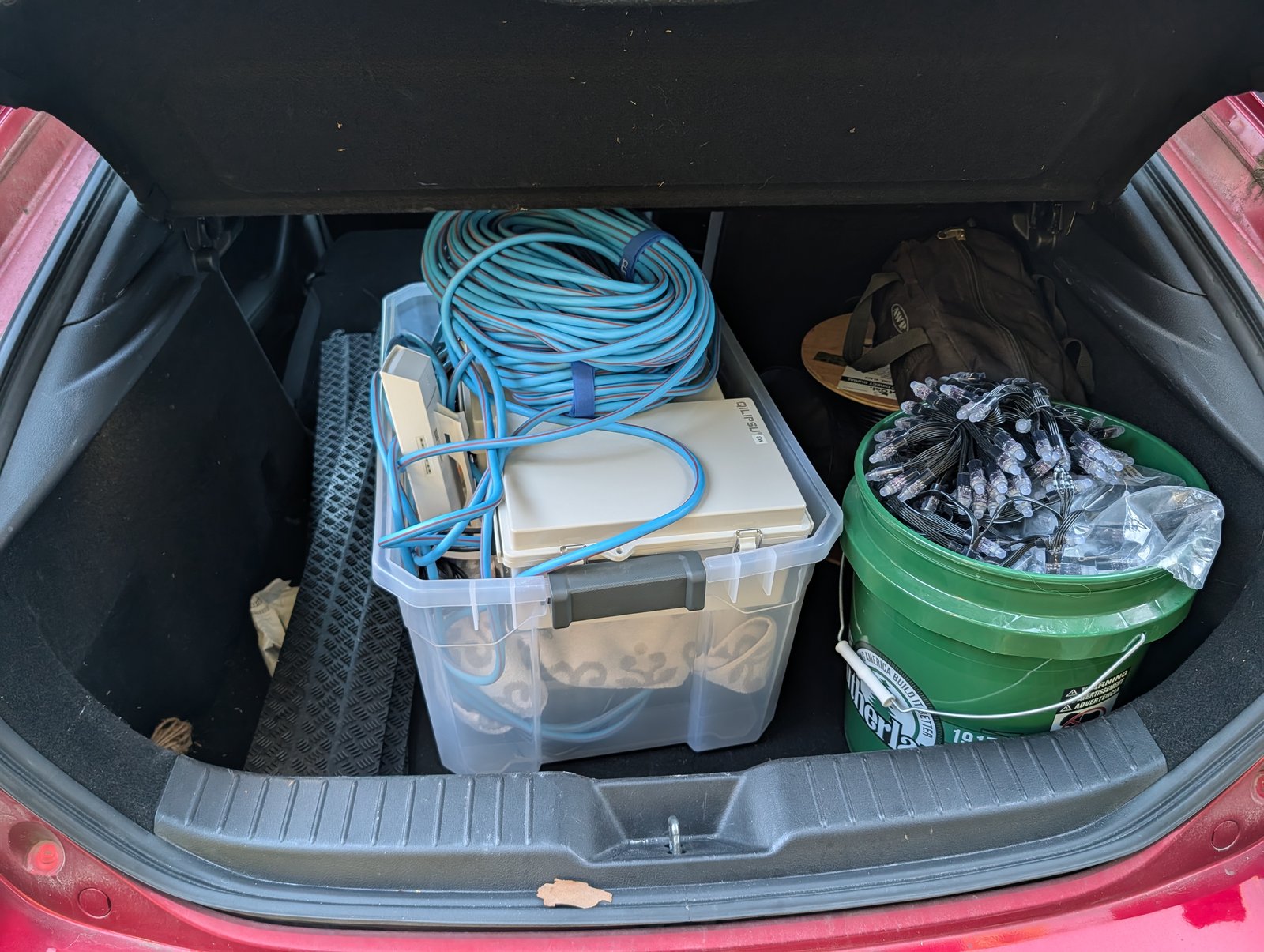
A season’s worth of infrastructure fits in a hatchback. Bucket of pixel strings, box of enclosure hardware, and the Cat5e that ended up in the ground.
The Pi doesn’t run FPP, which is the usual choice. It runs a few hundred lines of my own service: it polls the website every two seconds to find out what’s playing and when it started, renders frames from the same shared modules the browser uses, pushes them through a calibration stage, and streams sACN to the Falcon at 40 frames per second. It’s a headless phone that happens to be wired to the lights.
The house is about 350 feet from the fountain, across a park, with trees in the way. That link is an Omada point-to-point bridge, and I built everything on the assumption that it will eventually fail. Nothing public depends on it.
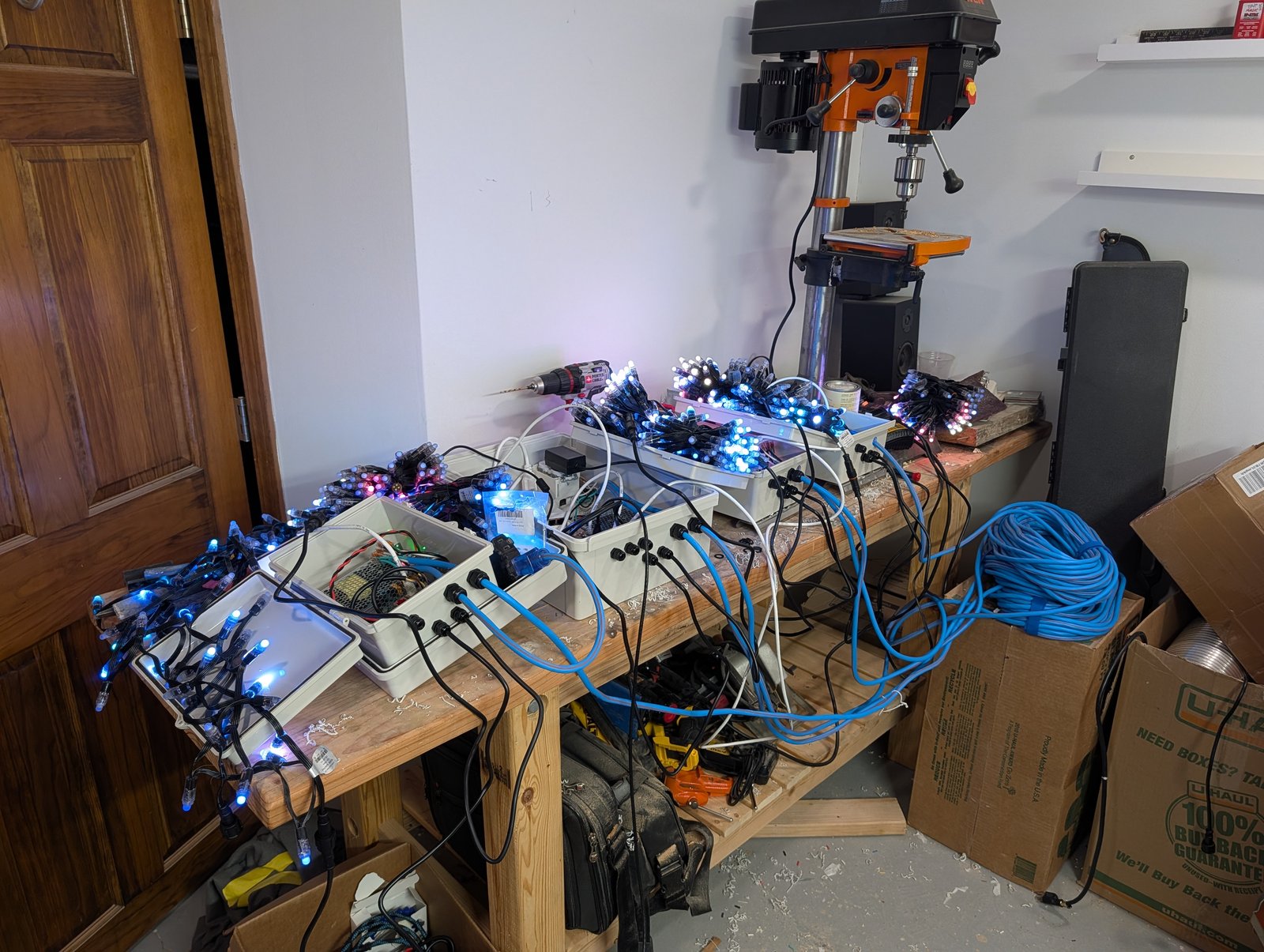
Bench testing. Four enclosures, four runs of pixels, and enough blue Cat5e to make the basement look like a crime scene.
Two hardware notes worth saving someone else the trouble. First: the Falcon’s JSON API will happily accept a partial write to its port table and truncate the rest, and the next write appends to the wreckage. I lost an evening to a port configuration that looked fine in the UI and made no sense on the wire. Back the config up, edit the backup, restore it in one shot.
Second: the Pi has no real-time clock, so after a power cut it boots believing it’s whenever it was when it shut down. The light schedule is computed from sunset, so a Pi that thinks it’s 9 PM will cheerfully light a public fountain at ten in the morning. A $3 DS3231 module fixed it — the kernel sets the clock 1.5 seconds into boot, before the network is even up.
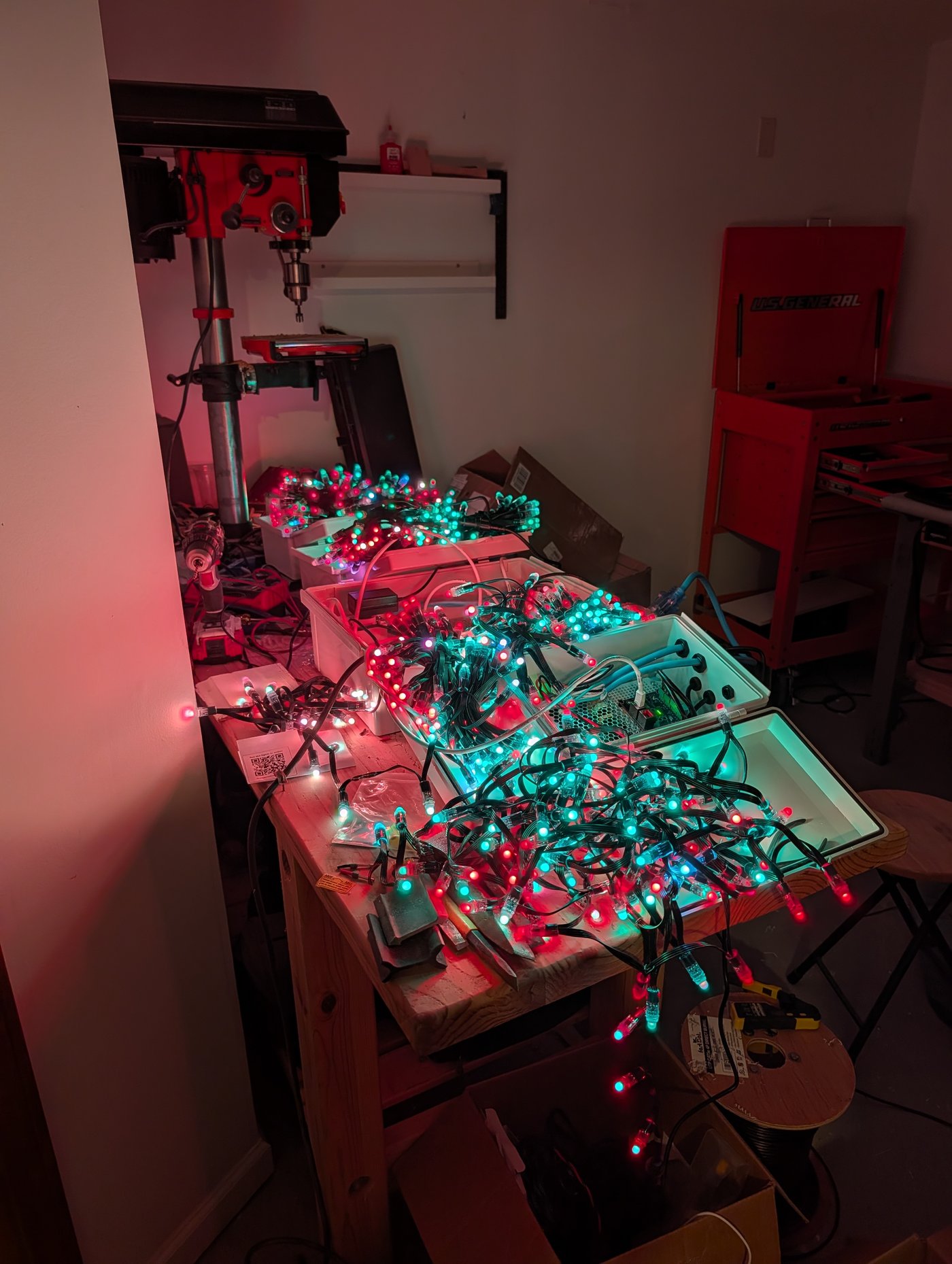
The same bench, lights on. This is also the entire development environment for the shows.
The website
The web app does not run on the Pi. It runs in a container at my house and is public at thefountainlights.com. That split is deliberate: a public website should not depend on a wireless bridge pointed across a park at a tree. The site stays up whether or not the fountain is lit, whether or not it’s even the season.
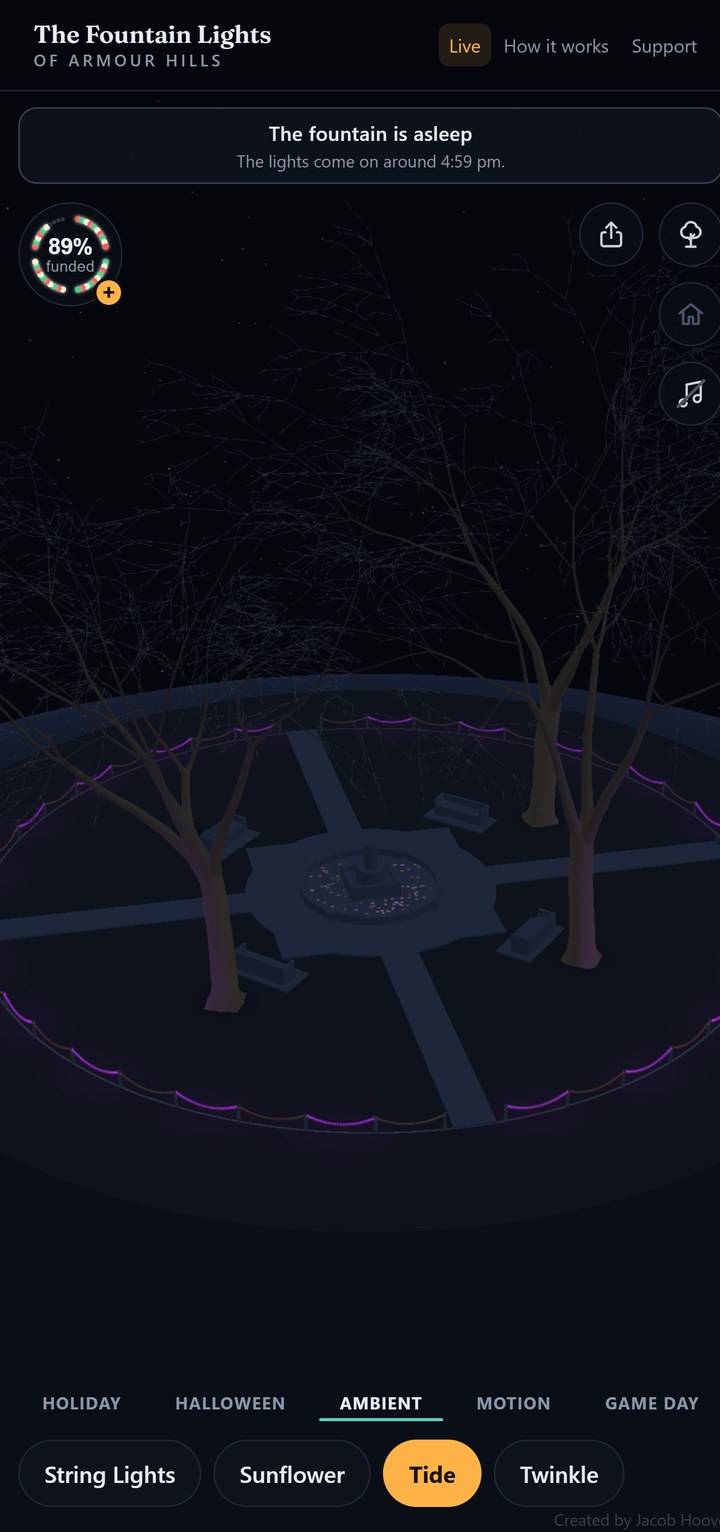
The site on a phone, caught during the day — it knows the fountain is asleep and tells you when the lights come back. The ring in the render is live: it shows what the real chain is doing right now.
The shows run on a jukebox model. Pick one and it plays; if someone else is waiting, you get ninety seconds and then it hands over; if nobody’s waiting it loops until it times out and the idle show comes back. Picks are anonymous by design — there’s no account, no name on anything, and the queue shows countdowns rather than people.
People react to the 3D view more than anything else. It’s the real fountain model, the real trees, and a real sky: all 9,096 stars of the Yale Bright Star Catalogue, the moon at its correct phase and position, and the planets out to Saturn, all computed from the clock to within an arcminute of where they actually are. None of it was necessary. It’s my favorite part.
What actually holds the whole arrangement together is duller: the browser, the server, and the Pi all render frames from the same modules, so the picture on your phone and the lights on the chain are produced by the same code at the same moment on the same clock. The one time that contract broke — the server was handing the browser a hand-built config that was missing the pixels-per-span value — phones drew 26 pixels per span while the chain lit 25, and everything looked subtly wrong in a way that took far too long to find. There’s a test for it now.
Designing shows for forty swags
I did not expect this to be the hard part.
The ring is 107 feet across, so the far side is a thin line at knee height about 35 yards away. I sat down and worked out what that actually means: one swag of chain subtends about 4 degrees from the far side, a single pixel is 10 arcminutes — a third of the width of the moon — and the entire 12 inches of sag is 32 arcminutes. The entire vertical dimension of the chain, all the sag that makes it a catenary, is one moon tall from across the water. Small figures drawn in a few pixels are invisible. You can work in swags, quadrants and the whole ring; anything smaller is texture.
I learned this the expensive way. The first song show was built from the lyrics up: twenty-six scenes in three minutes, each one a small clever picture that fired on a word and vanished. Measured afterward, the lights averaged 18% of full brightness, a quarter of the ring was above half brightness only 11% of the time, and the correlation between the music’s intensity and the light’s was 0.05. It was correct, clever and flat. You could not tell from across the street that anything was happening.
The rewrite started from a different place: draw the intensity curve for the whole show first, place the climax, place the dark on purpose, and only then decide what happens. Every section gets a sustained ground — a big state across the ring that carries it — and events ride on top of that ground instead of replacing it. Repeats escalate. Full brightness over the full ring is what a climax looks like, and the power budget covers it, so use it. Now I check every show against those numbers before it goes near the fountain.
There are a couple of dozen shows on the picker. A bonfire that burns in each swag, merges into one fire per quadrant, becomes a ring of fire, spins up into a whirl and burns down to coals. A storm whose lightning strikes one place and lights the cloud from the inside, then changes the ring’s color under the flash. Two minutes of fireworks built from how real shells actually behave, and a second set that breaks those rules on purpose. A carol with its own synthesized bell arrangement, locked to the lights. The newest two are a self-playing game of Snake on the ring as a thousand-cell board, and a study in Doppler shift — a moving source whose waves bunch up ahead of it and stretch out behind, until it’s pacing as fast as its own waves and they pile into a front it can’t outrun.
Working with Claude Code
Essentially all of this was written with Claude Code — the website, the pattern runtime, the Pi service, the astronomy, the shows. It’s worth describing how that actually goes, because it isn’t “ask for a light show, receive a light show.”
What works: describe the show, get a draft deployed to the real site within the hour, and then watch it on the actual chain in the dark. Notes go back in plain language, and the useful ones are almost never technical. “Bursts that happen at exactly the same time and height feel artificial; subtle variation feels organic” produced a better fireworks show than any amount of parameter tuning. “The exact same data over and over again is what gets stale” killed a sorting visualization that was technically fine. “The motion reads as a glitch” killed another one outright.
What doesn’t work is anything that needs a caption. Left alone it will cheerfully build a show about, say, strain spreading along the fence as something leans on it — which is a lovely idea and completely invisible, because a ring of lights can show light moving and cannot show a force. The rule we ended up with is that if the honest description is “the light represents X,” it’s dead. The other persistent failure is scale: a single bright pixel is a point of texture, not a figure, and that has to be re-learned on about a monthly basis.
The fix for both is measurement. Every show gets run through a script that reports its average brightness, how much of the ring is above half, where the energy sits across the loop, and how long the worst frame takes on the Pi’s budget. “It looked fine in the preview” is not a standard. The 18% number is the reason that script exists.
The neighborhood part
I presented the project to the HOA board, which gave it its full support, and then went door to door. Materials are the only cost and the neighbors are funding them; design, fabrication and installation are donated. Three signs stand at the open sidewalk entries — 18 by 12 inches, a QR code, and as few words as I could manage.
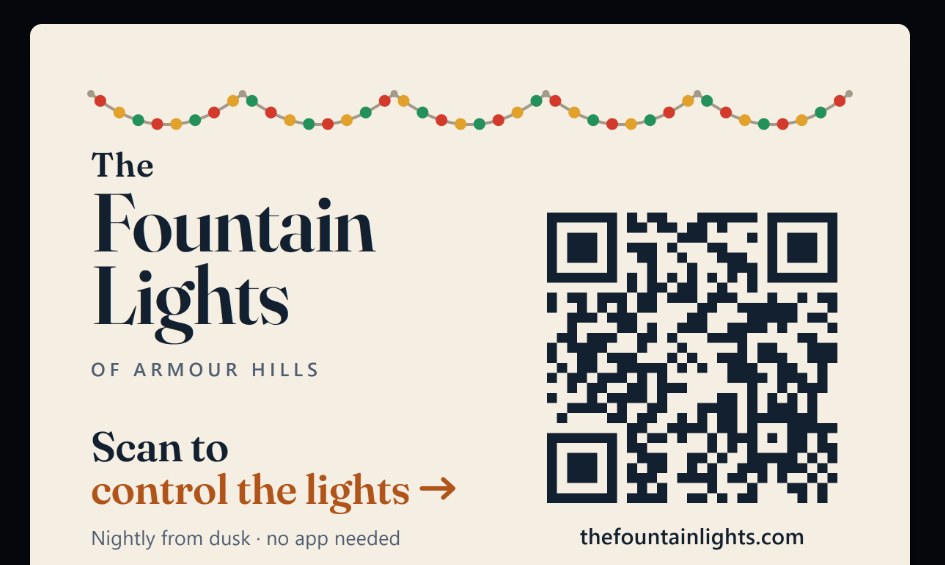
The sign. Scanning it at the fountain is what unlocks picking — if you’re not there, you can still watch.
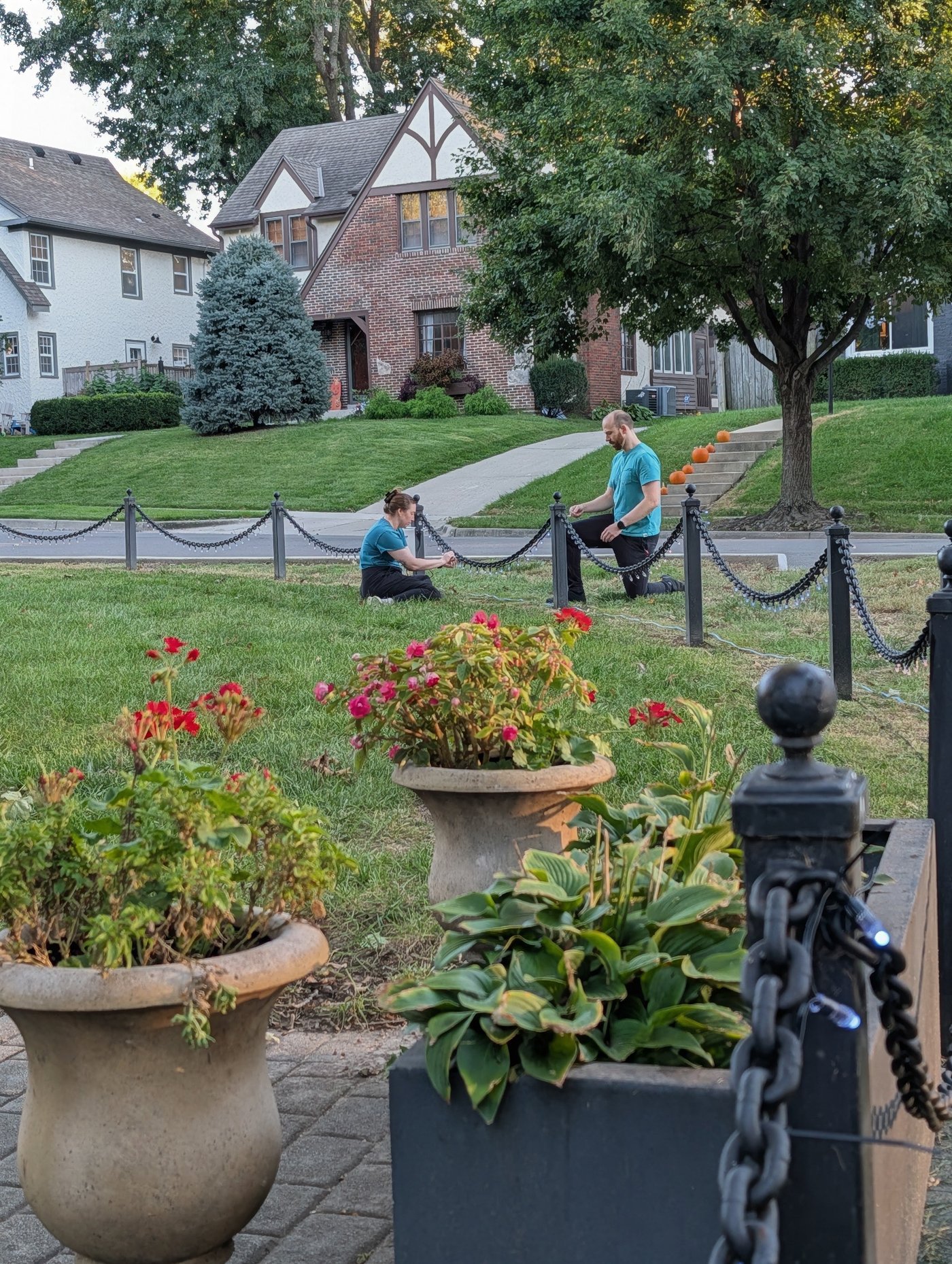
Installation day. My wife and our friend Tom, clipping 1,000 pixels to a chain fence one at a time. This took considerably longer than the schematic suggested.
It runs nightly from twenty minutes before sunset, picking closes at ten, and the lights go dark at eleven. The season runs from late October to January, at which point a thousand pixels come back off that chain one at a time and I find out how good my labeling was.
thefountainlights.com — thanks for looking!