Nudge: a mirror that texts me
My phone buzzes while I’m scrolling: “Hard freeze Sunday night: drain the hose bibs.” It isn’t an ad or a feed. It’s my own software. It knows the forecast, it knows my house, and it knows I said I was tired of remembering this stuff the day after it mattered.
If your time is short: Nudge is a private app that sends me a few notifications a day. Each one pairs something I care about with something true right now, and ends with one small thing to do. The screenshot below uses made-up demo content, because the real thing knows far too much about me.
Why
I wrote this line down early on: the opportunity to make informed decisions is vast, the ability is small. Most of what would change my week is already knowable. There’s a deadline, a city rule I’ve never heard of, a pipe full of tree roots. It just never reaches me at a moment when I could act on it. The poison isn’t what I don’t know. It’s what I don’t know I don’t know.
So every nudge has the same shape:
something I care about x something true right now -> a move
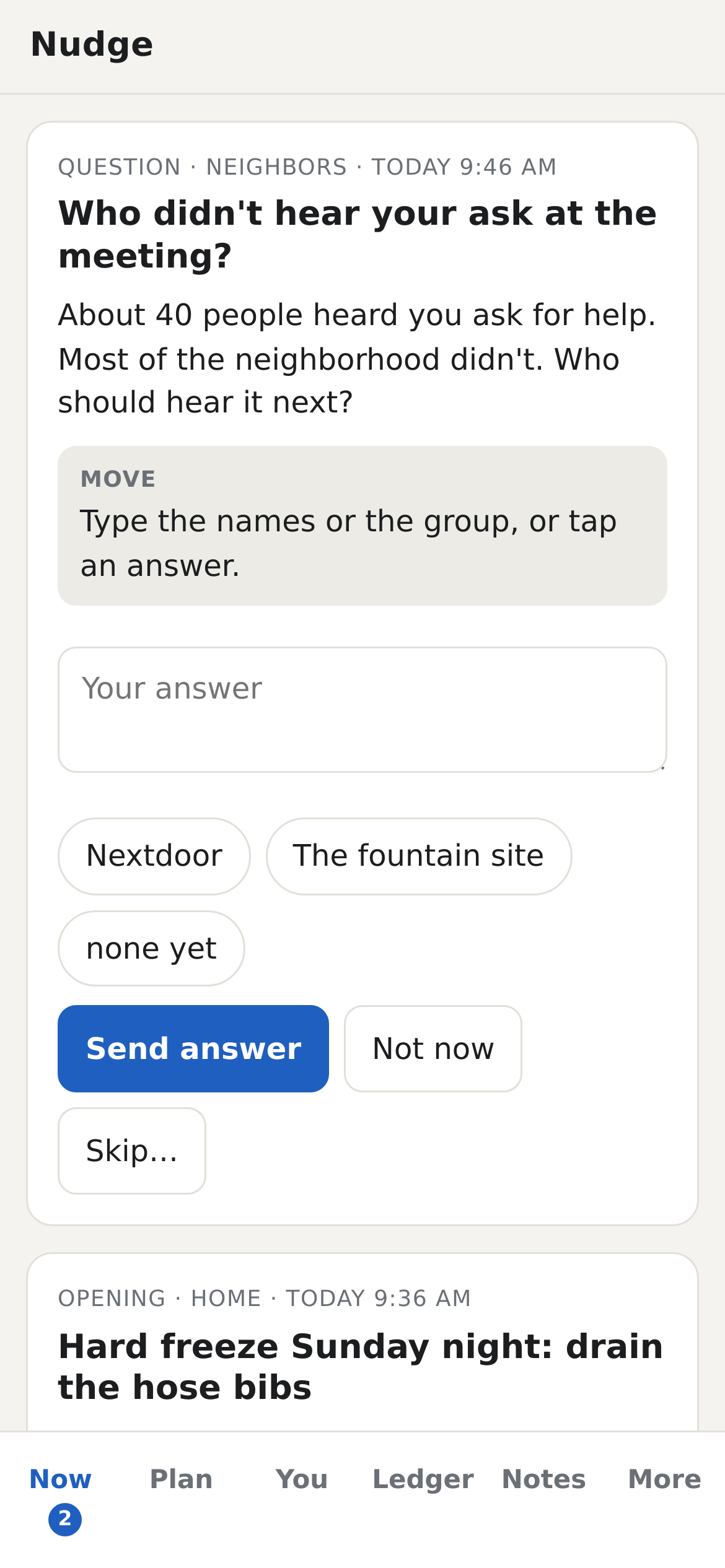
There’s a daily cap, and silence is a valid answer. Cards come in when I can actually look at my phone. I can’t carry it at work, so that’s mornings and evenings. Question cards take a typed answer or one tap.
How it works
Two small containers on my homelab. One is a plain web app on my phone with no AI in it. It queues cards, delivers them, and keeps a ledger of the things that actually became real. The other is the engine. A few times a day it gathers what’s true: the forecast, a digest of my email, a summary of my bank exports, what my projects are doing. Then it makes one call to Claude, which can read all of that and search the web, but can’t write, send or change anything. It hands back a few candidate nudges as structured data. Plain Python checks them before anything gets queued.
When I say I’ll do something, it asks later whether it happened. Most of the value turned out to be there.
Email is text written by strangers, so it’s treated as information and never as instructions. The engine can only update what it believes about me when it can point to something I actually did.
It’s a mirror
A few days in, I realized the alerts aren’t the interesting part. What I want most is an honest mirror. In an analog life that comes from friends and the world pushing back on you. A good therapist is the deliberate version: objective, armed with tools, on your side. This is a digital version of that.
So the app has a page called “How Nudge sees you”. It lists what I say I value, the evidence for and against each one with sources, where I’ve grown, and what it can’t see. Corrections from me count more than anything else it observes. The analogy breaks in useful places, and each break became a design rule. It only sees what leaves a data trail, so it has to say what’s outside its view. Ignoring a digital mirror costs nothing, so follow-through matters. And it isn’t a therapist, so anything serious gets pointed at a human.
I ranked what it does: mirror, then keeper of promises, then route-setter (the next move sized to where I am now, not where the goal ends), then scout. The scout is the part that was easiest to build, which is probably why I built it first.
Honest status
It’s days old. The ledger is short. A run costs well under a dollar, and the mirror redraws once a day. The things I’m watching are how many nudges actually change what I do, and whether it ever feels like a scold. Next up: an “I’ve got time” button for when I want a move instead of waiting for one. Eventually it should run on a local model, so none of this leaves my house.